Checklists
Washroom cleaning checklist in working order
A washroom cleaning checklist in working order: every visit, daily and weekly tasks, plus a two minute inspector's version to check the result.
November 12, 2026 · 4 min read
A washroom cleaning checklist works best when it follows the order of the job: top to bottom, dry to wet, clean to dirty. That order stops you spreading dirt onto surfaces you have already finished.
Below is a commercial washroom cleaning list split into tasks for every visit, daily tasks and weekly or periodic tasks. At the end is a short version a supervisor can run in about two minutes. If you call it a restroom cleaning checklist, it is the same list.
What order should you clean a washroom in?
Use the same sequence every time.
- Top to bottom. Dust and wipe high surfaces first so debris falls onto floors you have not cleaned yet.
- Dry to wet. Do dry tasks first, such as emptying bins and restocking, then move to wet cleaning.
- Clean to dirty. Do mirrors, counters and sinks before toilets and urinals. Mop last, working back to the door.
Use separate, colour coded cloths for toilets and urinals, and never use them on sinks or counters. Keep the same mop and bucket order too: washroom floors last, and never a mop that has touched a toilet area on an office floor.
Every visit tasks
These are the tasks to repeat on every pass, especially in busy buildings with a day porter.
- Put the wet floor sign out and prop the door.
- Empty the bins and replace the liners.
- Check and refill soap, paper towel and toilet paper.
- Wipe door handles, push plates, stall latches and flush handles.
- Spot clean mirrors, sinks and counters.
- Wipe toilet seats and rims, and flush each toilet and urinal.
- Remove visible spills and debris from the floor.
- Report anything broken, such as leaks, dead lights or loose seats.
Daily tasks
- Clean and disinfect toilets and urinals, inside and outside, including the base and behind the seat hinges.
- Clean sinks, taps and the area around the drain.
- Clean mirrors until they are streak free from two angles.
- Wipe the counters, the dispensers and the outside of the bins.
- Wipe stall doors and partitions at hand height and splash height.
- Sweep the floor, then mop it, including corners and under the edges of fixtures.
- Check the floor drains for debris.
- Empty the sanitary bins and replace the liners.
- Leave a dry floor, or a sign where it is still wet.
Follow the disinfectant label. Contact time matters, so do not wipe the product off right after spraying it.
Weekly and periodic tasks
- Scrub grout lines and the floor around toilets and urinals.
- Descale taps, shower heads and the underside of sinks.
- Dust vents, ledges, light fixtures and the tops of partitions.
- Wash walls and partitions, including the tops of stall doors.
- Clean the inside of bins and sanitary containers.
- Wash or replace mop heads and cloths.
- Deep clean the floor drains.
- Spot check caulk and grout for mould and report any damage.
Set the periodic tasks on a rotation so they do not all land in one week. Record when each one was done, so you can show it to the client.
The inspector's version: ten things to check in two minutes
A supervisor does not need to re-clean the washroom. They need to check ten things in about two minutes. Walk in, stand at the door, then work around the room.
- Smell: no odour of urine or strong chemical when you walk in.
- Toilets and urinals: clean inside and under the rim, with no marks on the base.
- Sinks and taps: no water spots or residue.
- Mirrors: streak free from two angles.
- Dispensers: soap, towels and toilet paper stocked and wiped.
- Touch points: door handle, latches and flush handles clean.
- Floor: no standing water, no debris, and clean grout near the toilets.
- Partitions and walls: no splashes or marks.
- Bins: emptied and fitted with a liner.
- Drains and corners: no build-up, no cobwebs.
Mark each as pass or fail. Take a photo of any fail and assign it to someone with a due date. The janitorial inspection checklist has the same approach for the rest of the building.
How do you prove the washroom was cleaned?
A sign-off sheet on the door shows when someone visited. It does not show how well the job was done. The washroom cleaning log post explains how to keep one, including what to check in the current Ontario rules.
Pair the log with an inspection. The log shows the visit. The inspection shows the result.
Inceplio is an inspection app for cleaning companies. You can build the ten point list above as a form, inspect on a phone, attach photos and send a scored report. Details are at inceplio.com.
Common questions
How often should a washroom be cleaned?
It depends on traffic and what the contract says. Busy washrooms need several visits a day. Quiet ones may need one.
What is the difference between cleaning and disinfecting?
Cleaning removes dirt and soil. Disinfecting uses a product to kill germs on a clean surface. Always clean first, then disinfect, and follow the label.
What supplies belong on the cart?
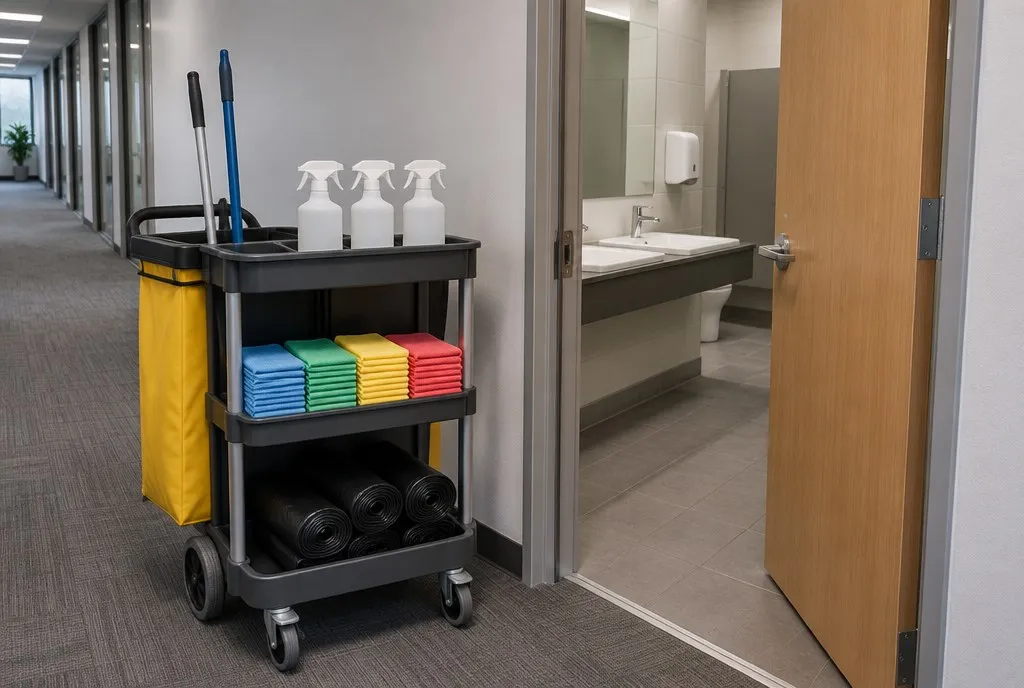
Colour coded cloths, a toilet brush, spray bottles, spare liners, refills for dispensers, gloves, a wet floor sign and a mop and bucket.